
Google Just Lost Its Crown: What Every Marketer Must Know
Google Just Lost Its Crown: What Every Marketer Must Know Before Planning Their Next Campaign
Google Just Lost Its Crown: What Every Marketer Must Know starts with this for close to two decades, one platform sat at the very top of the digital advertising world without a serious rival in sight. Google was not simply a search engine. It was the backbone of the entire internet economy, the destination where people went when they needed something, and the stage where brands competed hard to be visible the moment that need appeared. Its hold on advertising revenue felt less like a competitive advantage and more like an unbreakable law of the industry.
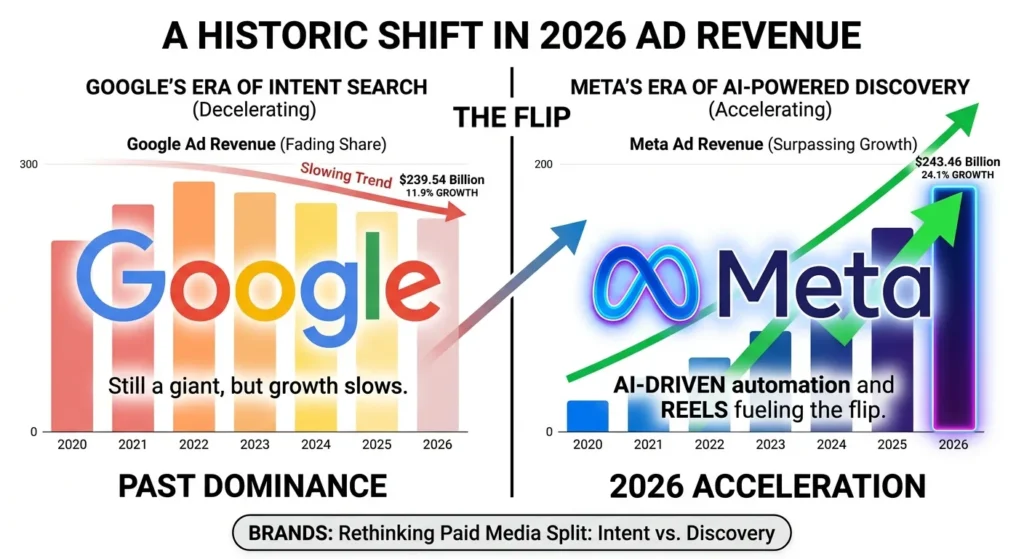
That law just changed, and Google Just Lost Its Crown: What Every Marketer Must Know is the conversation the entire industry is now having. In 2026, for the first time in digital advertising history, Meta is projected to overtake Google in global ad revenue. According to eMarketer, Meta is on track to generate $243.46 billion against Google’s $239.54 billion a crossing that looks extraordinary when you remember that just twelve months earlier, in 2025, Google held a lead of nearly $18 billion. The numbers are not speculation. The momentum is not a temporary fluctuation.
This is not a minor reshuffle in a league table buried in an analyst footnote. Google Just Lost Its Crown: What Every Marketer Must Know is a loud, data-driven signal that the rules of digital advertising have genuinely shifted that where audience attention lives online, where paid budgets deliver the strongest returns, and what creative and targeting strategies actually produce results in 2026 look meaningfully different from even two years ago. If your paid media strategy has not been seriously questioned recently, the moment to question it is right now.
Google Just Lost Its Crown: What Every Marketer Must Know About the Three Forces Behind Meta's Rise
Google Just Lost Its Crown: What Every Marketer Must Know is not a story about one lucky product decision. Meta’s climb to the top of the global ad revenue table was built across three interconnected forces that compounded over multiple years and together produced an advantage large enough to close an $18 billion gap and completely flip the leaderboard. Understanding each one matters because each carries a direct and practical lesson for how advertising budgets should be managed today.

Reels Became One of the Highest-Performing Ad Surfaces in the World
Short-form video was already growing fast before 2026, but Instagram Reels changed the scale of what Meta could commercially extract from the format. By 2025, Reels was carrying more than half of all Instagram ad placements. AI-driven recommendation improvements pushed US Reels watch time up more than 30% year over year, delivering more engaged eyes to ad placements that were already converting well. When you understand Google Just Lost Its Crown: What Every Marketer Must Know, you understand that Reels is not a trend it is the new commercial centre of Meta’s business.
eMarketer projects Reels alone will generate around $50 billion in ad revenue over the next twelve months. That is not a niche format working out its early momentum. That is a primary revenue channel operating at the kind of scale that most entire platforms never reach across their full lifetime. Meta’s commitment to making Reels the heart of its advertising ecosystem is now producing returns that show up unmistakably in the revenue numbers every quarter.
Advantage+ Made High-Performance Advertising Accessible at Every Budget Level
Advantage+ is Meta’s AI-powered campaign automation suite, and its maturation over the past two years is central to why Google Just Lost Its Crown: What Every Marketer Must Know matters so much for day-to-day advertising operations. Advantage+ Shopping Campaigns and Advantage+ App Campaigns allow advertisers to hand Meta’s machine learning system a budget and a goal, then step back while it identifies the best audience, creative combination, and placement mix automatically, continuously, and faster than any manual team.
For performance marketers, Advantage+ removed a significant layer of daily guesswork from campaign management. For Meta, it built a platform that advertisers found genuinely hard to walk away from once results began arriving. Brands that saw strong ROI kept scaling spend, and the results held over time. The broader automation stack including AI-generated creative tools and wide audience modelling reinforced the cycle and drove sustained budget consolidation onto Meta’s platforms at every level of advertiser, from global brands to independent businesses.
First-Party Data Built a Structural Advantage No Competitor Could Quickly Replicate

While the rest of the advertising industry scrambled to adapt to the effective end of third-party cookie targeting, Meta held a structural advantage that had been quietly building for years. Its logged-in user base across Facebook, Instagram, WhatsApp, and Threads 3.5 billion daily active users provided a depth and continuity of first-party behavioural data that competing platforms simply cannot match at comparable scale. This is a core part of Google Just Lost Its Crown: What Every Marketer Must Know data reliability is what kept advertiser confidence in Meta’s platform when uncertainty hit everywhere else.
Advertisers working to maintain precision targeting in a post-cookie world found that Meta’s ecosystem was one of the very few places where performance did not meaningfully degrade. That reliability became a decisive competitive signal, translating into sustained budget reallocations across multiple quarters that compounded into the revenue gap eMarketer is now measuring in the billions.
Google Just Lost Its Crown What Every Marketer Know, Your Questions Answered
Q: Does this mean we should move our entire Google budget into Meta right away?
A: No, and understanding Google Just Lost Its Crown: What Every Marketer Must Know means understanding that this is not a simple budget swap. Google Search still captures purchase intent at the precise moment a user is ready to act. When someone types a product name, a service, or a question into a search bar, that intent signal remains extraordinarily valuable and is hard to replicate in a social environment. What this shift tells you is that brands consistently underweighting Meta relative to search have likely been leaving measurable performance unrealised. The right move is a data-led, careful rebalancing based on your specific audience, category, and conversion evidence not a reactive wholesale shift triggered by a headline.
Q: Does this shift matter for smaller businesses running limited ad budgets?
A: Directly and strongly. Google Just Lost Its Crown: What Every Marketer Must Know is as relevant in Riyadh and Dubai as it is in New York or London. Instagram and Facebook carry some of their highest global penetration rates across Gulf markets, with strong daily active usage, high engagement figures, and a young digitally active population that represents some of Meta’s most commercially valuable audiences worldwide. Reels adoption across the MENA region has closely tracked the global curve. Advertisers in Saudi Arabia and the UAE still allocating the majority of paid social budget to basic boosted posts and broad targeting are not accessing the full performance capability available and they are being outperformed by brands running smarter campaigns on the same platforms.
Google Just Lost Its Crown: What Every Marketer Must Know About Google's Real Structural Challenges
It would be a misreading of Google Just Lost Its Crown: What Every Marketer Must Know to frame this as Google falling into decline. Its $239.54 billion in projected 2026 ad revenue is a remarkable figure by any standard, and Google remains one of the two or three most essential platforms in any serious digital marketing strategy. An 11.9% annual growth rate is solid by most business measures.
The challenge is not the absolute number it is the momentum gap. Meta is growing at 24.1%, more than double Google’s pace, and that gap compounds over time. Google also faces structural headwinds that are not quickly reversible: AI-generated search summaries are already reducing click-through rates on paid placements, zero-click results are eroding returns on both organic and paid search, antitrust pressure is creating regulatory uncertainty across major markets, and younger audiences are increasingly discovering products through social feeds and AI tools rather than by typing search queries.
The intent-based model that built Google’s two-decade dominance is being disrupted from multiple directions at once and that is the deeper structural truth behind Google Just Lost Its Crown: What Every Marketer Must Know.
Google Just Lost Its Crown: What Every Marketer Must Know About Restructuring Their Media Budget
The practical takeaway from Google Just Lost Its Crown: What Every Marketer Must Know is a budget question every advertiser needs to answer honestly. The default allocation most brands operated on for a decade 60 to 70 percent toward Google Search with Meta and other channels dividing the rest made complete sense when search intent was the most reliable signal available. In 2026, that default no longer reflects where the strongest blended performance sits for most advertisers.
A more balanced allocation committing meaningful investment to Reels-first creative, actively testing Advantage+ Shopping campaigns, and building retargeting infrastructure through Meta’s pixel and first-party data tools is consistently producing stronger combined results for performance-focused advertisers right now. The point of Google Just Lost Its Crown: What Every Marketer Must Know is not to abandon search it is to stop treating Meta as a secondary brand awareness layer and start running it as a genuine full-funnel performance channel with its own dedicated creative, testing, and optimisation strategy.
In practice this means building video-native creative designed specifically for Reels placement rather than repurposing static assets, running Advantage+ and manual campaigns side by side to generate real benchmarks, and using Meta’s creative testing tools to identify what resonates before scaling spend. Brands approaching this methodically are not reacting to a headline. They are building an advertising operation structurally aligned with where audience attention and commercial results live today.
Every Marketer Must Know About the Wider Industry Reshuffling
Google Just Lost Its Crown: What Every Marketer Must Know is also a story about market concentration. Meta, Google, and Amazon together are projected to control 62.3% of all global digital ad spending in 2026 up from 59.9% the year before. The concentration of advertising power at the top of the market is not softening. It is intensifying, with a reshuffled internal hierarchy that reflects where consumer attention, platform innovation, and advertiser returns have genuinely moved.
Social media now commands approximately 40% of total global digital ad spend the largest single channel share in the industry. That figure tells a story that goes beyond the Meta-Google comparison at the top: an entire category of advertising that is automation-led, creative-first, and built around social behaviour has become the dominant commercial force in digital marketing. Brands building genuine expertise inside Meta’s ecosystem now hold a compounding advantage.
Act On Before the Competition Does
Google Just Lost Its Crown: What Every Marketer Must Know is not a story about two technology companies trading positions on an annual forecast. It is a story about where human attention has genuinely moved, how advertising automation has matured to the point of delivering real performance advantages at scale, and what kinds of creative strategies and targeting approaches are producing measurable results for brands in 2026.
The platforms that invested consistently in short-form video, AI-driven automation, and first-party data built structural advantages that eventually became impossible to overcome through incremental improvement alone.Google is not finished and search intent is not disappearing. But the era of defaulting to search-heavy media allocations without seriously examining whether that default still serves your specific audience, category, and growth stage is over.
Google Just Lost Its Crown: What Every Marketer Must Know is a call to build genuine fluency across both ecosystems understanding clearly what Google does irreplaceably well and what Meta now does better and letting clean data and disciplined testing drive every allocation decision rather than historical habit or platform inertia.
If you are revisiting your paid media strategy in light of this historic industry shift and want someone who understands both the data behind the change and the practical execution required to act on it with real results, a Freelance Digital Marketing Expert in Riyadh can help you build a media mix that reflects exactly where the market stands today and positions your brand to perform strongly as the advertising landscape continues to evolve.